
Many of you might know but some of you don’t know that this past week we celebrated Yom Kippur. For those of you who don’t know, Yom Kippur is the day of atonement, a day for reflection, thought, forgiveness and the beginning of a new year. It’s a good day for thinking about what you can do differently, what changes you might make to become a little bit better and to make this world a little bit better. And once you have thought about it, figured it out, you can actually go ahead and do something, whether large or small, to make it happen. Of course it’s more complicated than that but so am I and I’m not into long, involved explanations of either. You know how you can find out more. About Yom Kippur that is.
The thing is, I didn’t really come here today to talk about Yom Kippur. I came here to talk about pears and genetic reversion. Mostly because it appears to be happening in my own backyard. Literally. And it’s something you probably don’t know much about. Especially when it comes to pears.
Ok. It’s the season once again when I should be writing in that other blog of mine (no I’m not expecting you to read it) about all the things I have been baking with pears. You know, having one pear tree would keep me busy enough but I happen to have two pear trees which, to be completely honest, is more than a little overwhelming. Just how many pear recipes do you think there are? I’ve made the quiche. I’ve made the muffins, the loaves and the crumble. I’m thinking about the scones and even the pear tart with the puff pastry but I’m putting my foot down when it comes to the “perogies with sausage, cabbage and pear”. I mean why not just throw pears into anything? Like chocolate cake and pears? Wait! I made that! But this is not my baking blog and I’m not talking about recipes here. I’m talking about genetic reversion.
Maybe I better step back a bit. If you have read this blog for as long as it’s been written, you’ll know that when we first moved to our new little spot on this Island of ours, we decided to plant a pear tree in our tiny yard. Mostly because my Father had planted a pear tree in the backyard of the house I grew up in. Not that we ever ate those pears. They were always too hard for us to eat so we gave them away to be canned by someone who knew more about canning than we did. What we didn’t know then, and we do know now, is that pears don’t actually ripen on the tree. Pears need to be picked and left to ripen on the counter. Who knew?
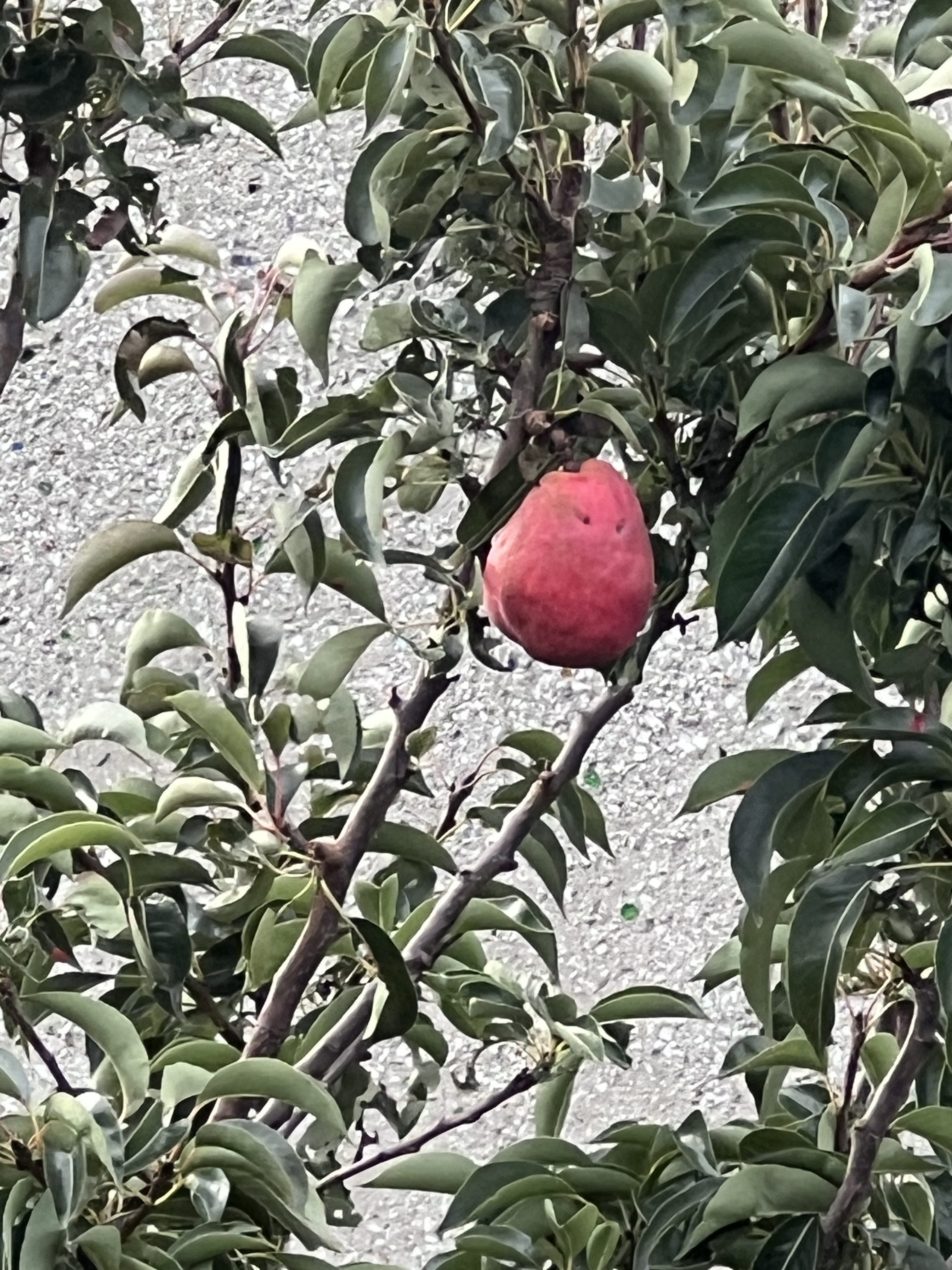
Anyway, for some reason when we moved into the new house, we somehow were convinced that in order to get pears we actually needed to have two pear trees. You know, pollination. It made sense, to us at least, although I’m pretty sure you could have told us anything to sell us a couple of extra trees. Hence two pear trees in our tiny backyard. One grew green pears and the other grew red. “Red Sensation Pears” to be exact. And for 10 years that’s exactly what we got. Green pears from the green pear tree and red pears from the red one. And then we didn’t.
Here’s what happened. It started in late spring as the pears started to emerge from their flowery beginnings. At first I thought I was seeing things. Maybe the coffee was too strong. Too much chocolate so early in the day? But each day as I inspected my beloved trees (yes I have grown quite fond of them over the years) I discovered that some of the red pears, the ALWAYS red pears from beginning to end, were green. Not every branch. Not the entire tree. But some. How could this happen? How was it that pears, formerly known as red, were now completely and unmistakably green? I was perplexed, although not everyone in the house felt the same way as I did.
Me: The red pears are green.
Him: So?
Me: They didn’t just turn green, they are green!
Him: So? You know there are green pears.
Me: Of course I know there are green pears! On the green pear tree but not on the red tree.
Him: Hmmmm
Now you might be thinking that this shallow gal has too much time on her hands when I tell you that this situation screamed out to me for some research. Surely there must be a reasonable explanation for why a Red Sensation tree, after 10 years of reliably producing red pears, would suddenly, and without any provocation on my part, decide to create green ones. And that’s how I found out about genetic reversion. You see, red pear varieties can result from natural mutations that humans discovered and, quite sensibly, decided to propagate. In another life this Red Sensation was a Green Bartlett tree. And now, for some unknown reason, some of its branches have decided they liked their “other” life better than this one. So they took back their life. To tell you the truth, I’m ok with that. Because who doesn’t like a Bartlett pear? But it did make me think.
What if genetic reversions happened to people? Imagine waking up one morning and discovering that your curly hair had become straight. Your brown eyes had turned blue. And somehow the first words out of your mouth when you woke up were “Chyba przeszedłem rewersję genetyczną!” I bet that would get more than a “hmmmm”. That would be one heck of a change!
Which takes me back to Yom Kippur. (You knew I’d get there eventually.) It’s the beginning of a new year. A time for reflection. A time to think about what makes life meaningful. And what changes you can make to bring meaning to your own life. You don’t have to turn from red to green. You don’t have to wake up speaking Polish. It doesn’t have to be anything big. Just one small thing. And then you just have to do it. No genetic reversion required.
PS: If I may, a word of advice. I’d still refrain from putting pears in perogies with sauage and cabbage. Trust me. It’s not going to make the world even a little bit better.


I think perogies with cabbage, sausage and pears would be yummy!
Writer’s licence. It just wouldn’t have worked for the story. 😉